Pool Maintenance Cost in Ontario: What It Really Costs to Run a Pool Each Year
Most people ask what a pool costs to build and forget to ask what it costs to own. Pool maintenance cost in Ontario is not one number, it is a stack of small bills: chemicals, hydro for the pump, gas or electricity for heat, an opening in May, a closing in the fall, water, parts, and a quiet reserve for the liner and equipment that will wear out. This guide puts a 2026 GTA price on every line, builds three realistic annual budgets, and shows where the cost to maintain a pool can honestly be cut without creating a bigger bill later.
Ryan Roy
Lead Pool Specialist, Swimpool 360
- Written for the Toronto & GTA Market
Annual Pool Maintenance Cost Breakdown for Ontario
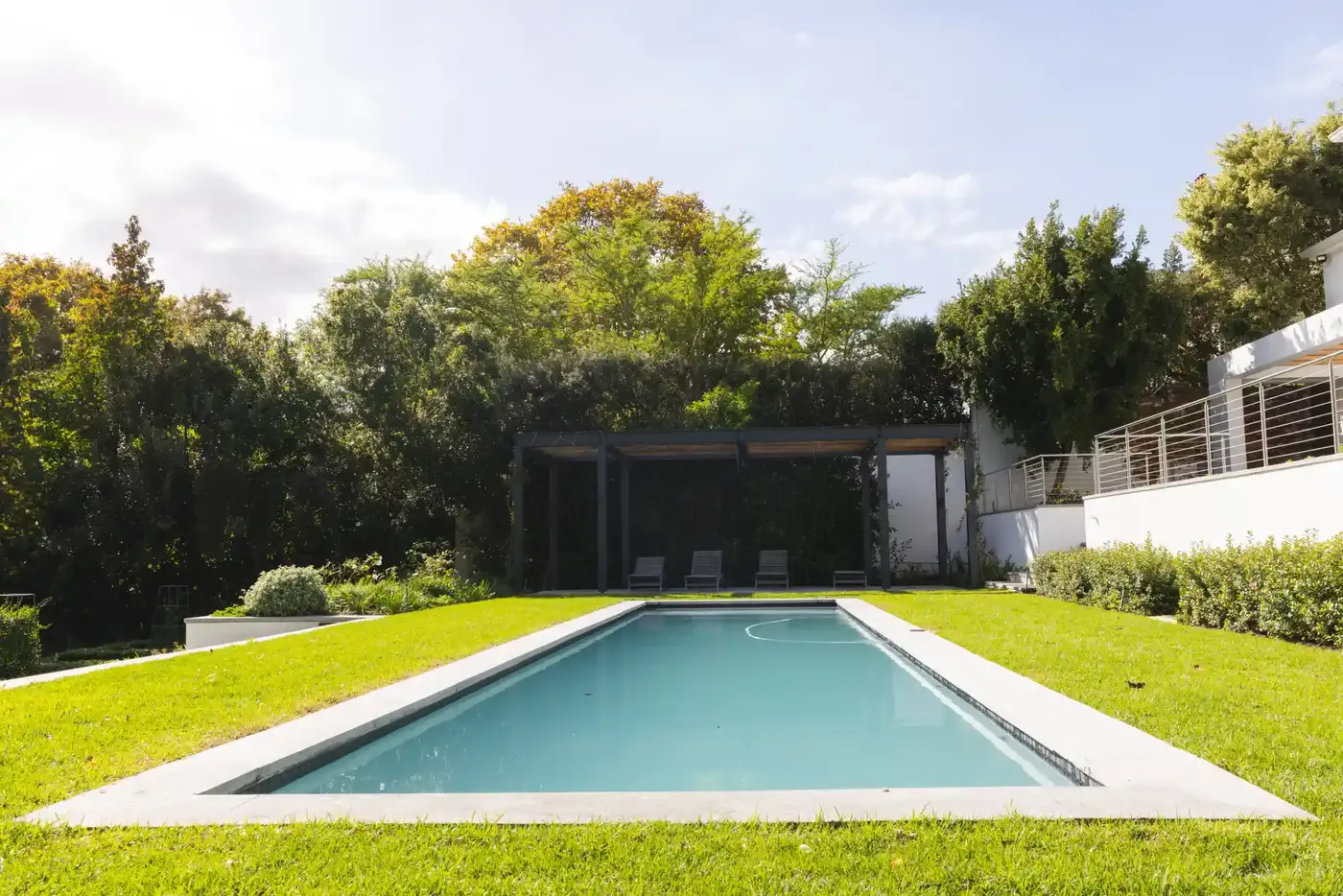
The figures below assume a standard 16 by 32 foot inground vinyl pool in the GTA, a swim season from late May to mid-September, and heating for about three to four months. A smaller pool, a plunge pool, or an above-ground pool will sit toward the low end of every range. A large freeform pool under mature trees will sit at the top.
| Line Item | Typical 2026 Cost per Season | What Moves It |
|---|---|---|
| Chemicals, chlorine pool | $400 to $800 | Bather load, sun, debris, how often the water goes off balance |
| Chemicals, salt pool | $50 to $100 salt plus $150 to $300 balancers | pH drift, which salt pools push upward; cell reserve listed separately |
| Pump hydro, single speed | $500 to $1,000 | Horsepower, run hours, time-of-use rates |
| Pump hydro, variable speed | $100 to $250 | Speed schedule and whether the pump also drives a heater or cleaner |
| Heating, natural gas | $250 to $600 per month heated | Target temperature, wind exposure, cover use |
| Heating, heat pump | $100 to $250 per month heated | Air temperature; efficiency drops in cool May and September nights |
| Heating, solar | Near zero beyond pump time | Sun exposure and panel area |
| Professional opening | $200 to $400 | Pool size, water condition under the cover |
| Professional closing | $250 to $450 | Number of plumbing lines, heater, water features |
| Weekly service (if hired) | $100 to $200 per visit, about $1,600 to $3,200 a season | Visit frequency and pool size; our plans include visit chemicals |
| Water top-up | $50 to $200 | Evaporation, splash-out, backwashing, municipal water rates |
| Small repairs and parts | $150 to $500 | O-rings, baskets, gauges, cartridges, test supplies, a service call |
| Replacement reserve | $500 to $2,000 a year | Liner age, heater type, pump age; explained below |
Chemicals: the line that punishes inconsistency
Owners at the low end of the $400 to $800 chlorine range test two or three times a week and correct small drifts. Owners at the high end let things slide, then buy their way back with heavy shock and algaecide. A salt pool spends far less on sanitizer but still needs acid, because salt chlorination nudges pH up. Our salt water vs chlorine comparison covers the full ten-year picture.
Pump hydro: the biggest hidden bill
The pump runs every day of the season, so an older single speed model quietly outspends almost everything else at $500 to $1,000 a season, against $100 to $250 for a variable speed pump. If yours is old, our pool pump repair and replacement guide explains when to stop fixing it.
Heating: the line you choose
Heating is optional, and it swings the budget more than any other choice. Over a three to four month heating season, gas works out to roughly $750 to $2,400 and a heat pump $300 to $1,000. The pool heater guide breaks those numbers down by pool size.
Pool opening and closing cost
The pool opening and closing cost for an inground pool in the GTA is roughly $200 to $400 for the spring opening and $250 to $450 for the fall closing. Closing costs more because every line is blown out and plugged and the equipment drained, and it is where shortcuts hurt most: freeze damage can run from $500 to well over $5,000.
Three Example Budgets for a GTA Pool
Most people want to know which column they will land in. These three profiles cover most of the residential pools we look after across Toronto, York Region and Durham. None includes the replacement reserve, which has its own section.
| Line Item | DIY Minimal | Typical Owner | Fully Serviced, Heated |
|---|---|---|---|
| Chemicals | $400 to $700 | $400 to $800 | Included in visits |
| Pump hydro (variable speed) | $100 to $250 | $100 to $250 | $100 to $250 |
| Heating | None | Heat pump, $300 to $750 | Gas, $750 to $2,400 |
| Opening | Owner does it | $200 to $400 | $200 to $400 |
| Closing | $250 to $450 | $250 to $450 | $250 to $450 |
| Weekly service | Owner does it | Owner does it | $1,600 to $3,200 |
| Water and parts | $150 to $450 | $200 to $700 | $200 to $700 |
| Annual running cost | $900 to $1,850 | $1,450 to $3,350 | $3,100 to $7,400 |
DIY minimal
Unheated water, a variable speed pump, an owner who does the weekly care and the opening, and a professional closing. It is the leanest realistic way to own an inground pool here. The one place we would not save is the closing, because a frozen line is entirely the owner's bill.
Typical owner
The owner handles weekly care, a professional opens and closes, and a heat pump keeps the water comfortable from June into September. Most of our clients land here. Swap the heat pump for gas and the total moves toward $3,000 to $5,000.
Fully serviced, heated
About 16 weekly technician visits with chemicals supplied, and a gas heater running from opening to closing. With a single speed pump, add another $400 to $750 in hydro. Seasonal plans that bundle opening, weekly visits and closing usually beat booking each separately.
Weekly Pool Maintenance: DIY or Hire?
Weekly pool maintenance is the work that keeps every other cost down: testing and adjusting the water, skimming, brushing walls and steps, vacuuming the floor, emptying the skimmer and pump baskets, and watching the filter pressure. Done weekly it takes an owner an hour or so. Skipped for two weeks in a hot July, it becomes a weekend.
DIY makes sense when
- Someone in the house genuinely enjoys the routine and will test at least twice a week
- The pool has a robotic or automatic cleaner doing the floor work
- You are home most of the summer and can catch a problem the day it starts
Hiring makes sense when
- You travel in July or August, which is exactly when algae grows fastest
- The pool sits under maples or oaks and the skimmer fills daily
- You have had a green pool before and would rather not repeat it
Our weekly pool maintenance service runs $100 to $200 per visit, with chemicals included, and bi-weekly visits suit pools with light use. A common middle path is to hire weekly service for July and August only and handle June and September yourself, when the water is cooler and more forgiving.
The corner that gets cut: some low-price services dip a test strip, drop in a tablet and leave in ten minutes. Strips do not measure calcium hardness or stabilizer properly, and stabilizer creeping too high is one of the most common reasons a chlorine pool turns cloudy in August despite "plenty of chlorine". Ask any service you hire what they test, how they test it, and whether you get a written record of each visit.
The Long-Term Reserve Nobody Budgets For
Running costs are only half of the true cost to own a pool. The other half arrives every eight to fifteen years in larger amounts, and owners who have not set money aside often end up putting off a liner or pump until it fails at the worst moment. Spreading these over their expected life gives a yearly figure you can actually save toward.
- Vinyl liner: $4,500 to $8,500 installed, replaced every 8 to 12 years. That works out to roughly $400 to $1,000 a year. See the pool liner replacement cost guide.
- Pump: $1,200 to $2,400 installed for variable speed, typically 8 to 12 years, roughly $100 to $300 a year.
- Gas heater: $2,500 to $5,500 installed with a 7 to 12 year life, roughly $250 to $750 a year.
- Heat pump: $4,500 to $8,000 installed with a 10 to 15 year life, roughly $300 to $800 a year.
- Salt cell: $700 to $1,200 every 3 to 7 years, roughly $100 to $400 a year, if you run salt.
Add the lines that apply to your pool. An unheated chlorine pool needs roughly $500 to $1,300 a year in reserve, and a heated pool with salt can need closer to $2,000. Fiberglass pools have no liner to replace, which is one of their real long-term advantages. Concrete pools trade the liner for periodic resurfacing, which deserves its own line in the plan.
A practical habit: note the install year of the liner, pump, filter and heater. When one passes the middle of its life, ask for a condition check at closing and plan the replacement over the winter, not in June.
How to Cut the Cost to Maintain a Pool
Skipping a closing or stretching an old liner one more year usually costs more than it saves. These changes reliably lower the cost to maintain a pool in Ontario without moving the risk somewhere else.
Switch to a variable speed pump
The single largest saving for most older pools. Expect roughly $400 to $900 a year off the hydro bill and payback in two to four seasons. Running the pump longer at low speed also filters better than short bursts at full speed.
Put a solar cover on the water
A solar or thermal cover can cut heating costs by 40 to 70 percent, and it slows evaporation and chlorine loss too. Covers run about $150 to $800 depending on size and whether you add a roller. It only works if it is actually on, so a roller is money well spent.
Choose a heat pump over gas
For June through August swimming, a heat pump costs well under half as much to run as gas. Gas still wins for fast heat and very early or late season use, so match the heater to how you actually swim.
Keep the chemistry balanced every week
Balanced water uses less chlorine and protects the liner and heater. Our pool water chemistry guide covers target ranges and testing. One green pool recovery can cost more than a season of careful testing.
Use a proper winter or safety cover
A well-fitted cover keeps leaves and sludge out over winter, so the spring opening is a cleanup rather than a rescue. Compare options in our safety cover vs winter cover guide.
Clean the filter by pressure, not by habit
Backwashing too often wastes water and chemicals, and too rarely strains the pump. Clean when the gauge reads about 8 to 10 PSI above its clean baseline. Our filter cleaning guide covers each filter type.
Insurance and Property Assessment Notes
Two costs never appear on a pool quote, and both are worth checking before you build or buy.
Home insurance
Tell your insurer when a pool is added. Some adjust the premium, some recommend higher liability coverage, and some have conditions around fencing, diving boards or slides. It varies widely, so get the details in writing. Having the enclosure permit and final inspection on file makes that conversation easier. Our Ontario pool permits and fences guide covers the usual requirements.
Property assessment
In Ontario, the Municipal Property Assessment Corporation (MPAC) assesses property values for property tax, and permanent features such as an inground pool can be considered as part of a property's characteristics. Whether and how much a pool changes your assessment depends on the property and the assessment cycle, so confirm with MPAC or your municipality rather than relying on a rule of thumb.
Does a Pool Add Value to a Home in the GTA?
It is one of the most searched questions about pools, and the honest answer is that whether a pool adds value to a home depends on who is buying, where, and what shape the pool is in. Nobody can promise a pool will raise your sale price.
Where a pool tends to help
- Detached homes on larger lots in family neighbourhoods, where comparable homes also have pools
- Pools that are well kept, with a newer liner, efficient equipment and a finished, landscaped surround
- Pools that still leave usable lawn for young children
Where it can work against you
- Small lots where the pool takes the entire yard
- Markets where many buyers are downsizers or first-time buyers who see upkeep and safety rather than summer
- Tired pools: an old liner, a single speed pump and a cracked deck become line items in a buyer's offer
It is uncommon to recover the full build cost at resale. Build a pool because your family will use it, and keep it in condition so it is an asset rather than a discount when you sell. Records help. A folder with the building permit, the ESA certificate for the electrical work, equipment install dates and service history tells a buyer the pool has been looked after.
Budget Now for Next Season
October is the best month to plan next year's pool budget. The closing visit shows how the liner, pump, filter and heater are holding up, so any replacement can be quoted and scheduled over the winter instead of in the spring rush. Opening slots across the GTA fill quickly once the weather turns, and booking in winter gets you the date you want rather than the one that is left.
If the closing turned up something worth fixing, our pool repair team can quote it now so it is done before the cover comes off. And if you prefer to hand off the whole season, a seasonal service plan bundles opening, weekly visits and closing into one predictable number.
The Bottom Line on Pool Maintenance Cost
Plan on roughly $900 to $1,850 a year to run an unheated pool yourself, $1,450 to $3,350 for a typical heat pump pool with professional opening and closing, and $3,100 to $7,400 for a fully serviced, gas-heated pool. Then set aside $500 to $2,000 a year for the liner, pump and heater that will eventually need replacing. The best savings come from a variable speed pump, a cover that is actually used, and steady weekly chemistry.
Swimpool 360 has opened, serviced, repaired and closed pools across Toronto, the GTA, York Region and Durham since 2010. If you want a seasonal plan priced for your pool, or a condition check before you budget for next year, call 647-239-7665. We respond to all inquiries within 24 hours.
Frequently Asked Questions: Pool Maintenance Cost
How much does pool maintenance cost per year in Ontario?
For a typical 16 by 32 foot inground pool in the GTA, expect roughly $900 to $1,850 a year for a DIY unheated pool, $1,450 to $3,350 for a typical heat pump pool, and $3,100 to $7,400 for a fully serviced, gas-heated pool. The DIY figure assumes a variable speed pump and a professional closing. The typical figure adds professional opening and a heat pump. On top of any of these, set aside $500 to $2,000 a year toward eventual liner, pump and heater replacement.
How much does weekly pool maintenance cost in the GTA?
Weekly pool maintenance in the Toronto area typically costs $100 to $200 per visit, or roughly $1,600 to $3,200 across a season of about 16 visits. With Swimpool 360 plans the chemicals used during visits are included, so the visit price replaces most of your chemical budget instead of adding to it. Bi-weekly visits roughly halve the cost and suit lightly used pools or pools with a robotic cleaner.
What is the pool opening and closing cost in Ontario?
A professional opening for a standard inground pool costs about $200 to $400 with starter chemicals, and a closing about $250 to $450. Above-ground openings run about $150 to $250. Closing costs more because every plumbing line has to be blown out and plugged and the equipment drained. Together the two visits come to roughly $450 to $850 a year, which is modest next to the $500 to $5,000 or more that freeze damage from a poor closing can cost.
Does a pool add value to a home in the GTA?
Sometimes, but it is never guaranteed. A well-kept inground pool on a larger suburban lot in a family neighbourhood can make a house more appealing to buyers who want one. The same pool can narrow the buyer pool elsewhere, because some buyers see upkeep, safety and insurance. Condition matters most, since an old liner or tired equipment becomes a negotiating point. Recovering the full build cost at resale is uncommon, so build a pool for your family's use rather than as an investment.
What is the easiest way to lower the cost to maintain a pool?
Replace an old single speed pump with a variable speed model and use a solar or thermal cover. The pump swap saves roughly $400 to $900 a year in hydro and usually pays back its $1,200 to $2,400 installed price in two to four seasons. A cover can cut heating costs by 40 to 70 percent while reducing evaporation and chemical loss. After those, steady weekly chemistry is the biggest saver, because recovering a green pool costs far more than preventing one.
Related pool guides and services from Swimpool 360: