Pool Lighting and Water Features in Ontario: LED Lights, Waterfalls and Real Costs
By the end of August the sun is down before the kids are out of the water, and that is usually when people notice how dark their pool really is. Good pool lighting turns the backyard into an evening space, makes night swimming safer, and does more for the look of a pool than almost any other upgrade for the money. This guide covers LED pool lights versus older bulbs, retrofit and new fixtures, the Ontario electrical rules, deck jets, sheer descents and waterfalls, landscape lighting, and what each one costs installed in the GTA in 2026.
Ryan Roy
Lead Pool Specialist, Swimpool 360
- Written for the Toronto & GTA Market
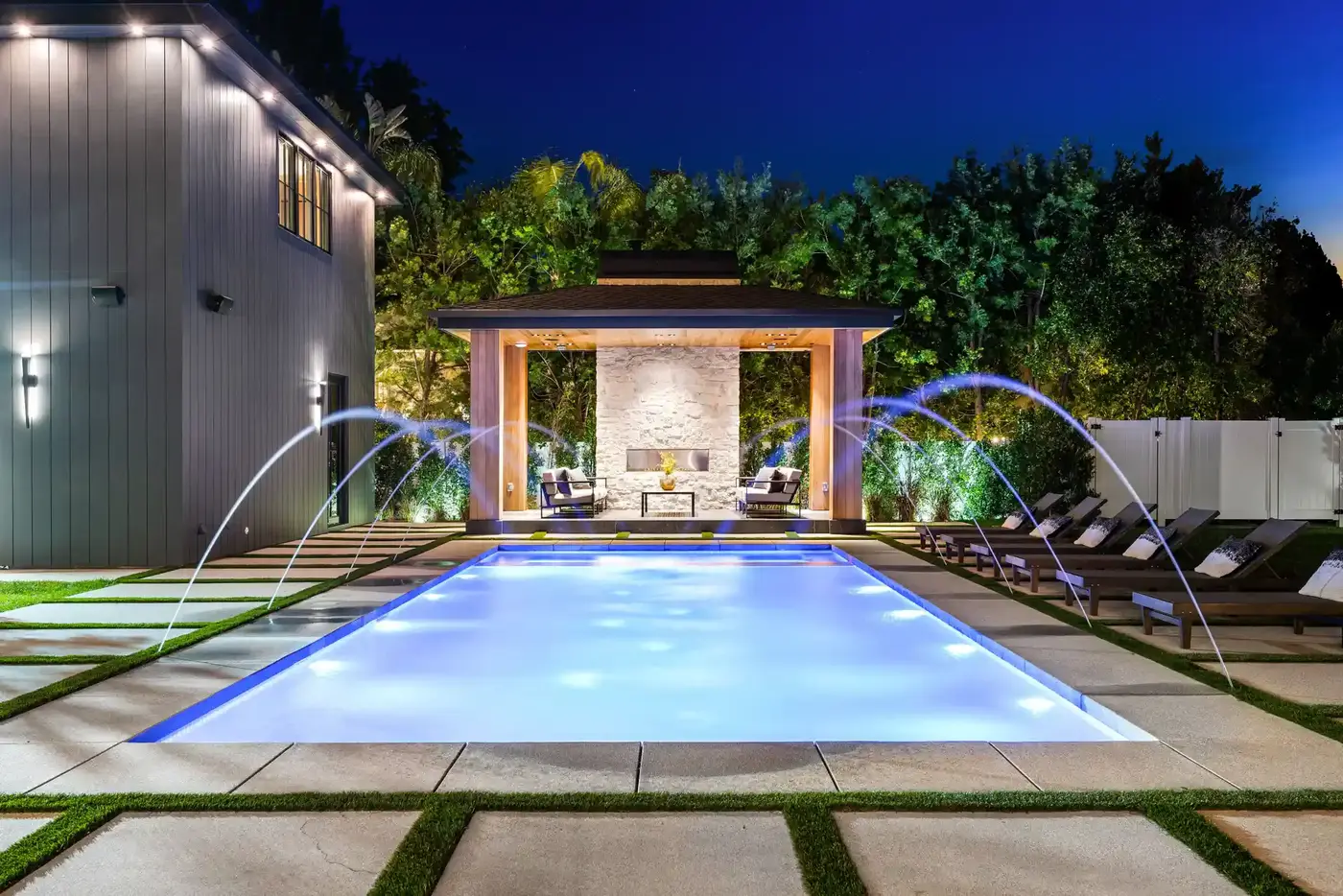
LED vs Halogen Pool Lighting
Most Ontario pools built before about 2012 have a single incandescent or halogen light in the deep end, usually 300 to 500 watts behind a glass lens. They throw a warm yellow light, burn out every year or two, and the replacement bulbs are steadily harder to find. Modern pool lighting is almost entirely LED, and for good reasons.
| Factor | Incandescent or Halogen | LED |
|---|---|---|
| Typical power | 300 to 500 watts | Roughly 75 to 85 percent less for similar brightness |
| Rated life | A few thousand hours | Tens of thousands of hours |
| Colour | Warm yellow-white only, or a coloured lens | Cool or warm white, plus full colour-changing models |
| Heat at the lens | High; must never run out of water | Low, though still designed to run submerged |
| Control | On or off | Dimming, colour shows, schedules, app control |
An honest note on hydro: a pool light only runs a few hours a night, so swapping one halogen for an LED saves tens of dollars a season, not hundreds. The pump is where energy money lives. The real case for LED pool lights is that they are brighter, last many seasons without a bulb change, and let you choose the colour of the water.
Colour-changing and app control
Cheaper colour-changing LEDs step through colours when you flick the switch off and on; better ones connect to an automation panel or Wi-Fi bridge so you can set colour, brightness and schedules from your phone. Two cautions: lights only stay in sync if they share a brand and control protocol, and most people end up using one soft white or blue most nights, so good white output matters more than party modes.
LED Pool Lights: Retrofit, New Niche or Surface Mount
Retrofit an existing niche
If the pool already has a light, the fixture sits in a wet niche in the wall with enough cord coiled behind it to lift it to the deck for service. An LED retrofit either replaces the bulb inside the existing fixture or swaps the whole fixture for an LED unit sized to the same niche. Budget roughly $400 to $900 installed. The installer must match the system voltage, since older pools may run 120-volt or 12-volt lights, and replace the lens gasket while the fixture is out.
Add a new niche
A new niche means cutting into the pool wall, setting the niche, running conduit back to a junction box, and bonding it. In a vinyl pool the liner has to come out or be cut around, which is why we strongly recommend adding niches when you replace the liner. Expect roughly $1,200 to $2,500 per niche, more if the deck has to be opened for conduit.
Surface-mount lights for vinyl and fiberglass
Low-profile surface-mount LEDs sit on the wall face and connect through a small fitting, often an existing return or a compact penetration, rather than a full niche. They are the practical retrofit for vinyl and fiberglass pools where cutting a large niche would be risky. Expect roughly $600 to $1,500 each installed. On a new fiberglass pool, plan light locations before the shell goes in.
Step, bench and accent lights
Small LED points in steps, benches and tanning ledges are inexpensive and show exactly where each step edge is at night. They are easiest to add during a build, liner replacement or renovation.
Low Voltage, Bonding and Ontario Electrical Safety
Water and electricity are the one backyard combination where a small mistake can kill someone. Most new pool lights are 12-volt fixtures fed by a pool-rated transformer, which reduces risk at the light but not the need for a proper circuit and bonding.
What a proper installation includes
- A pool-rated transformer sized for the total wattage of the lights, mounted where the code allows relative to the water.
- Ground fault protection on the pool lighting circuit, as required by the Ontario Electrical Safety Code.
- Bonding: metal parts of the pool system, such as niches, ladders, rails, the pump motor and heater, connected with a bonding conductor so there is no voltage difference between things a wet person can touch.
- Correct junction or deck boxes at the height and distance the code requires, so water cannot run back down the conduit into a connection.
- A notification to the Electrical Safety Authority (ESA) and an inspection, with the certificate kept with your pool records.
Do not DIY line-voltage pool wiring. In Ontario, hire a Licensed Electrical Contractor who files the ESA notification and arranges inspection. The corner that gets cut is bonding: a light gets swapped or a feature pump gets added and nobody connects the new metal to the bonding grid. It works fine until the day it does not. Clearances and bonding details change with code updates, so let the electrician and ESA confirm what applies to your pool.
Electrical work typically adds roughly $300 to $1,500 to a lighting project in the GTA, depending on the distance from the panel, whether a new circuit is needed, and how much deck has to be opened. Another reason to plan lighting before the deck is built.
How Many Lights Your Pool Needs, and Where
As a rule of thumb, one modern LED fixture lights roughly 300 to 500 square feet of water evenly. More lights at lower brightness look better than one blazing light, because they remove the dark corners and the hot spot.
| Pool Size | Underwater Lights | Notes |
|---|---|---|
| Plunge or small pool, under about 300 sq ft | 1 | Add step lights if there is a bench or ledge |
| 16 by 32 ft (about 510 sq ft) | 1 bright LED, or 2 for even light | Two lights on one long wall avoids a dark shallow end |
| 18 by 36 to 20 by 40 ft | 2 to 3 | Space them so the beams overlap slightly |
| L-shaped or freeform | 1 per zone | Each arm or lobe needs its own light |
Placement rules that matter
- Shine away from the main viewing area. Put lights on the wall closest to the house or patio, aimed away from it, so you see glowing water rather than staring into a bulb.
- Favour the deep end. Lights low in the deep end spread farther across the floor, and a deep-end light facing away from the patio is the classic single-light layout.
- Think about the neighbours. On tight GTA lots, a light aimed at the back fence can light up the bedroom window behind it. Check sightlines before the niche is set.
- Light the steps. Steps and entry points are where people misjudge depth at night.
Pool Water Features Explained
Pool water features add sound and movement, which is much of what makes a pool feel like a retreat. They also add plumbing, pump demand and something extra to winterize.
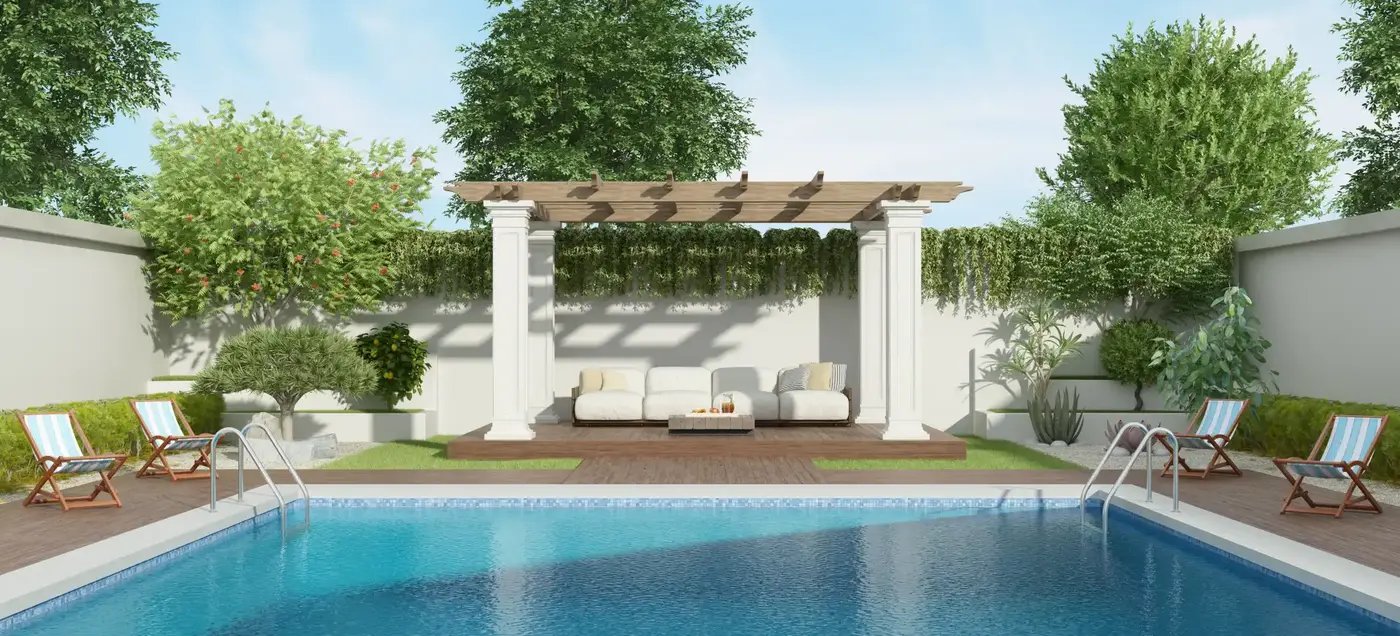
Deck jets
Deck jets are small nozzles set in the deck that arc a stream of water into the pool. They are the most affordable feature with real impact, especially in pairs or rows. Each needs its own supply line under the deck, so they are far cheaper to add while the deck is being built.
Laminar jets
Laminar jets produce a smooth, glass-like rod of water, and many carry an LED inside so the stream glows at night. They cost more than standard deck jets, roughly $1,500 to $3,500 each installed, and the units need more care at closing.
Sheer descents
A sheer descent is a stainless or acrylic lip set into a raised wall that releases a clean sheet of water. It suits modern designs and needs a raised wall or bond beam to sit in, plus enough flow for an even sheet.
Natural stone pool waterfall
A rock pool waterfall uses large stone, a waterproofed basin and concealed plumbing to look like it belongs in the landscape. It is a landscaping project as much as a pool project and needs machine access for the stone.
Bubblers and scuppers
Bubblers push a low dome of water up through a sun shelf or tanning ledge, and are popular with small children. Scuppers are spouts in a raised wall, in metal or stone, that pour a heavier stream. Both are usually planned into a new build or major renovation.
Simple fountains
Return-mounted or floating fountains are the low-cost option, often $50 to $300. They add sound and some cooling on hot days without any construction, though they will not look like a built feature.
Plumbing and pump needs
One or two deck jets can usually run off the main pump through a dedicated valve, especially a variable speed pump that steps up when the feature is on. Diverted flow is not filtration, so features should not replace normal filter hours. A big stone waterfall or wide sheer descent often needs its own pump, roughly $1,200 to $2,500 installed, wired and bonded like any pool pump. On an evening timer its running cost stays modest. Our pool pump guide explains why variable speed matters here.
2026 Installed Costs for Pool Lighting and Water Features
GTA ranges for 2026, assuming reasonable access and a sound existing pool. Deck removal and restoration can add to any line, so ask for an itemized quote.
| Item | Installed Cost (2026) | Best Time to Add |
|---|---|---|
| LED retrofit in existing niche | $400 to $900 | Any time, often at opening |
| Surface-mount LED light | $600 to $1,500 each | Any time, easier with water lowered |
| New light niche | $1,200 to $2,500 each | During liner replacement or renovation |
| Transformer, circuit and wiring | $300 to $1,500 | Before the deck is built |
| Deck jets | $500 to $1,200 each | During a deck build or rebuild |
| Laminar jets | $1,500 to $3,500 each | During a deck build or rebuild |
| Sheer descent | $2,000 to $5,000 (wall extra) | With a raised wall or renovation |
| Natural stone waterfall | $5,000 to $20,000 | With landscaping, before final grading |
| Dedicated feature pump | $1,200 to $2,500 | With the feature it serves |
| Landscape lighting | $150 to $400 per fixture | Conduit during hardscaping |
For context, most complete LED pool and landscape lighting packages on a typical GTA backyard land between $1,500 and $5,000. Water features are where budgets stretch, so decide early which one or two will make the biggest difference from where you actually sit.
Pool Landscape Lighting
Underwater lights make the pool glow, but pool landscape lighting is what makes the whole yard feel finished at night, and it keeps people from tripping on the way to the water.
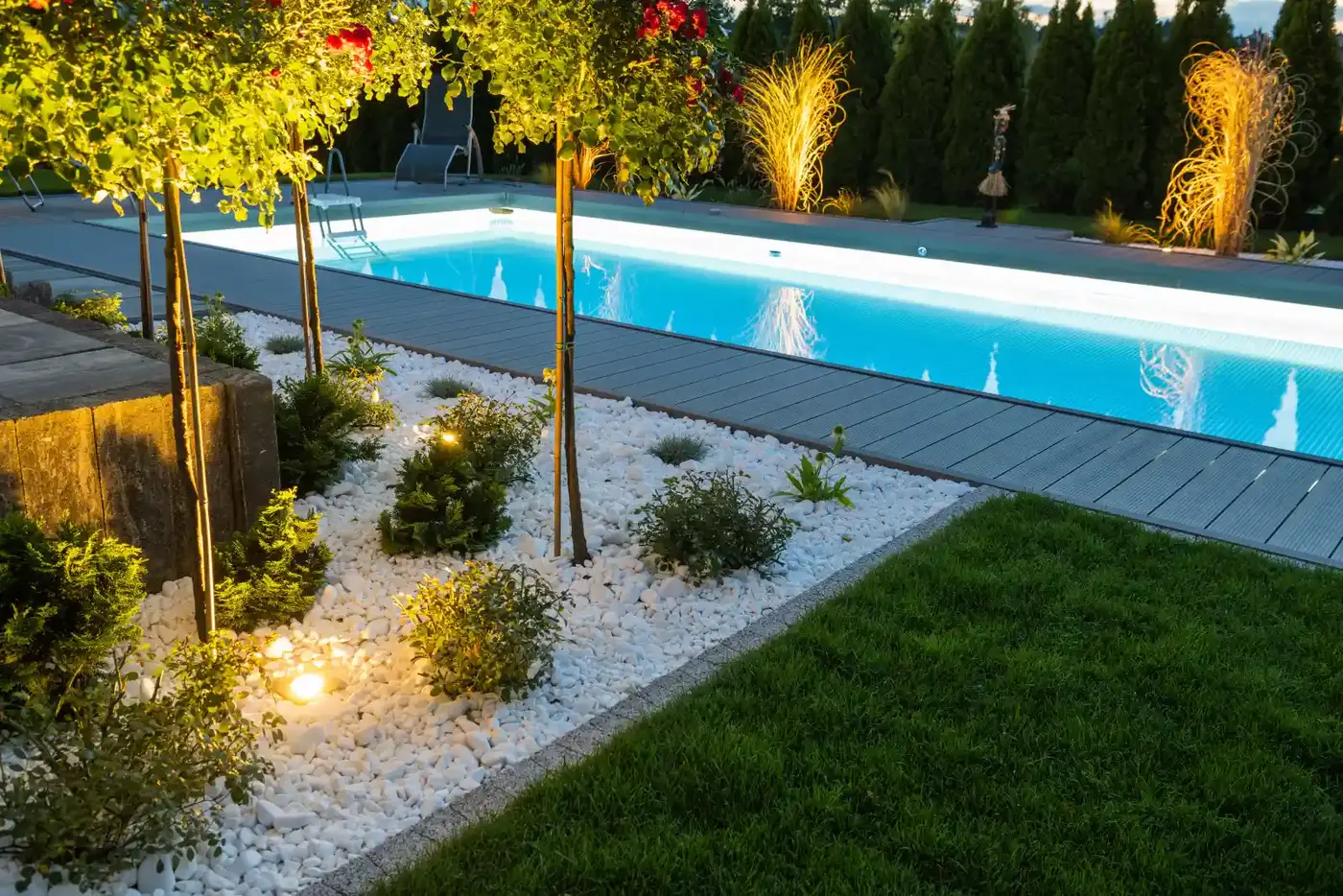
What works around a pool
- Uplights on grasses, shrubs and specimen trees to create depth beyond the water.
- Step and riser lights built into deck stairs and seating walls for safe movement.
- Path lights to the house and gate, spaced to avoid a runway look.
- Wall wash or downlights on pergolas and cabanas so the structure glows rather than glares.
Use warm white LEDs for planting and paving, even if the pool itself runs colour, and put the landscape lights on their own low-voltage transformer with a timer or photocell. Keep fixtures out of the splash zone, and run conduit before the paving goes down; retrofitting lights into finished interlock means lifting stone. Our pool deck materials guide covers the hardscape side, and our pool landscaping and hardscaping service plans lighting, planting and paving as one project.
Winterizing Lights and Features, and When to Install
At closing
Every water feature line has to be blown out and plugged at closing just like the returns, or it will freeze and crack under the deck. Drain sheer descent manifolds, protect or remove laminar units as the manufacturer directs, and drain feature pumps. For underwater lights, if the winter water level stays above the light it can usually stay in the niche. If the water is lowered below it, the fixture is lifted out of the niche and laid on a step or the floor under water, and the light is switched off for the winter. Never run a pool light out of the water. Our pool closing guide walks through the full process, and our closing service handles features as part of the visit.
The cheapest moment to add lights and features
Lighting and features cost the least when the pool is already opened up. A liner replacement is the ideal time to add niches and step lights, since the liner is out and the walls are exposed; see our liner replacement cost guide. A deck rebuild is the time for deck jets, conduit and landscape lighting. A larger pool renovation is the time for raised walls, sheer descents and stone waterfalls.
Plan in fall and winter, install with the spring opening
The end of summer is when a dark pool is most obvious, and the off-season is when there is time to design it properly. Settle the layout, fixtures and electrical plan over fall and winter, then schedule the work with the spring opening or a planned liner job. Waiting until June usually means waiting for a slot. If you are budgeting the bigger picture, our pool maintenance cost guide covers what a pool costs to run each year.
The Bottom Line on Pool Lighting
For most Ontario pools, the best first step in pool lighting is an LED retrofit at roughly $400 to $900, or new niches at $1,200 to $2,500 each when the liner is next replaced. Deck jets at $500 to $1,200 each are the most affordable water feature with real impact, while sheer descents and stone waterfalls are best planned with a renovation or landscaping project. Whatever you choose, the wiring goes to a Licensed Electrical Contractor with ESA notification, and every feature line gets blown out at closing.
Swimpool 360 has installed, renovated and landscaped pools across Toronto, the GTA, York Region and Durham since 2010, working with licensed electricians for the electrical side. If you want lighting or a water feature planned into your next liner, renovation or spring opening, call 647-239-7665. We respond to all inquiries within 24 hours.
Frequently Asked Questions: Pool Lighting and Water Features
How much does pool lighting cost in Ontario?
In the GTA in 2026, an LED retrofit in an existing niche costs roughly $400 to $900 installed, a surface-mount LED roughly $600 to $1,500, and a new light niche roughly $1,200 to $2,500 each. Landscape lighting adds about $150 to $400 per fixture installed. Most complete pool and landscape lighting packages on a typical backyard land between $1,500 and $5,000, with electrical work and deck access being the main variables.
Are LED pool lights worth it?
Yes, for almost every pool. LED pool lights use roughly 75 to 85 percent less power than incandescent or halogen bulbs, are rated for tens of thousands of hours instead of a few thousand, and come in white and colour-changing versions. The hydro saving on one light is modest, often tens of dollars a season, so the real value is brightness, colour and not pulling the fixture every year or two for a bulb that is getting harder to buy.
How much does a pool waterfall cost?
A sheer descent set into a raised wall costs roughly $2,000 to $5,000 installed, plus the wall, and a natural stone pool waterfall roughly $5,000 to $20,000. Stone size, machine access and water volume drive the stone waterfall price. Larger waterfalls often need a dedicated pump at roughly $1,200 to $2,500 installed plus its running cost. Adding the plumbing during a build or deck renovation is far cheaper than retrofitting it into a finished yard.
Can I install pool lights myself in Ontario?
Not the wiring. Pool lighting involves bonding, ground fault protection and clearance rules under the Ontario Electrical Safety Code, and mistakes around water can be fatal. Line-voltage work, transformers and new circuits belong to a Licensed Electrical Contractor who files the ESA notification and arranges inspection. You can choose fixtures and plan the layout, and plug-in low-voltage landscape kits are a separate matter, but anything wired into the pool system should be done by a licensed electrician.
How many lights does a pool need?
As a rule of thumb, one modern LED fixture lights roughly 300 to 500 square feet of water evenly. A small or plunge pool usually needs one light, a 16 by 32 foot pool one bright LED or two for even coverage, and an 18 by 36 or 20 by 40 foot pool two to three. L-shaped and freeform pools need one light per zone, and step lights add safety. Point every light away from the main viewing area so you see lit water, not glare.
Related pool guides and services from Swimpool 360: